Parking Guidance Solutions
Going Beyond the Building: Addressing Hospital Safety in Parking Facilities
Healthcare facilities have always been places of healing, compassion, and care. Yet in recent years, conversations...



When it comes to choosing the right parking guidance system, not all systems are created equal. A variety of technologies can be defined as a parking guidance system including puck, loop, zonal, ultrasonic, and camera-based. At first glance, these systems may appear to offer similar benefits, but when you dig a little deeper, the differences become clear.
For parking facility owners and operators, choosing to install a parking guidance system isn’t only about driver convenience. It’s a strategic investment in operational efficiency, customer satisfaction, and long-term profitability. These parking management systems reduce driver search time, alleviate congestion, and improve the overall driver experience, which leads to repeat business and increased revenue. Through specialized software like a Central Control System or Content Management System (CMS), they also provide valuable data insights operators can use to inform pricing, monitor trends, and optimize capacity. When combined with elements like license plate recognition (LPR), wayfinding signs, and integrated surveillance, a modern parking guidance system becomes a powerful platform for smarter facility management.
Legacy Loop Detectors
Wireless Puck Sensors
Broad Zonal Systems
Basic Ultrasonic Systems
High Performance Camera-Based Systems
Based on a comprehensive study of parking systems, “An inductive loop detector (also known as an Inductive loop traffic detector or Vehicle loop detector) is a vehicle detection method that utilizes the electromagnetic induction principle.”
Loop detectors consist of magnetic wire coils embedded in the pavement at each parking space or entry/exit lane. When a vehicle passes over or stops above the loop, it disrupts the magnetic field, triggering a signal that indicates occupancy or a count. Because of the way this technology works, loop systems require a delineator or barrier between parking spaces and driving lanes to ensure occupancy is recorded or cars are counted properly. These systems are typically found in older facilities. They lack the flexibility and data intelligence required for modern parking guidance applications.
| Pros of Loop Detectors | Cons of Loop Detectors |
| • Proven, legacy technology • Good for entry/exit tracking or gate control • Works reliably in consistent traffic environments | • Invasive installation (requires cutting into pavement) • Costly to install in each parking space • Difficult and costly to repair or replace • No visibility beyond basic occupancy (binary only) • No integration with LPR, surveillance, or analytics • Susceptible to damage from resurfacing or weather |
Puck sensors (sometimes called “wireless in-ground sensors”) are small, battery-powered devices embedded into the surface of each parking space. They detect vehicle presence through magnetic field disruption or pressure.
While loop and puck systems may seem attractive for certain environments, they fall short when it comes to delivering actionable insights or supporting modern parking needs like LPR, video surveillance, or integrated enforcement systems.
| Pros of Puck Sensors | Cons of Puck Sensors |
| • Less invasive than loop detectors • Wireless communication; no conduit needed • Suitable for outdoor, surface-lot installations • Faster install than loops in some cases | • Battery-powered (replacement every 5–10 years) • Still require pavement coring for installation • Vulnerable to environmental interference (water, snow, dirt) • Binary detection only (no license plate, video, or behavioral data) • Long-term maintenance and battery replacement can be costly |
Zonal systems (sometimes called "zone controllers") use ceiling-mounted sensors to monitor groups of parking spaces within a designated area or “zone”. Unlike single-space sensors that track each bay individually, zonal sensors detect whether any vehicle is present in the broader detection area which usually spans several spaces at once. The system then uses this aggregated data to indicate general availability (e.g., “5 spaces available on this level”) rather than pinpointing specific empty bays. This approach can reduce hardware and installation costs but offers limited visibility and accuracy, making it best suited for small facilities or environments where real-time precision is less critical.
| Pros of Zonal Systems | Cons of Zonal Systems |
| • Less hardware required than single-space solutions • Basic guidance at a lower cost • Simpler installation in some retrofit scenarios | • Lower accuracy due to shared zone detection • No individual space-level visibility • Cannot verify misuse, overstays, or unauthorized parking • Produces sensor noise • No integration with video, LPR, or behavioral analytics |
Ultrasonic sensors (sometimes called "ultrasound detectors") use sound waves to detect whether a vehicle is present in a parking space. The data they collect is binary (yes or no occupancy) and typically transmitted to a central system.
| Pros of Ultrasonic Systems | Cons of Ultrasonic Systems |
| • Low investment and installation cost • Widely available and easy to source • Simple real-time guidance with LEDs | • Require more infrastructure than other systems and can look cluttered • Sensors are installed close together which can lead to interference • Provide occupancy only rudimentary data • Noisy sensor technology • Accuracy is challenging to verify and must be checked visually, on site • Require manual, onsite performance monitoring • Higher installation costs with limited long-term value • Occupancy-based rather than camera-based • No ability to verify details of incidents in the facility (no potential for cost savings) • Installation often requires shutting down the level or sometimes the garage |
Ultrasonic systems offer a simple, entry-level option for facilities looking to move away from manual counting or loop systems. However, their binary nature, limited data capture, and reliability issues make them a less suitable choice for operations seeking detailed analytics, automated system health monitoring, or modern parking expectations like LPR, live video, or security integration. While this setup can work in small, simple environments, it lacks the intelligence, reliability, and functionality required by modern, high-volume facilities.
According to the comprehensive parking study, “This sensor is best suited for indoor applications due to not having the susceptibility to work under environmental changes such as snow and rain.”
In contrast, camera-based systems like the Park Assist Solution, an automated parking guidance system (APGS), do far more than detect vehicles. They deliver a high level of visibility to a comprehensive software platform for intelligent parking management.
“Over the years, we’ve seen every type of parking guidance technology in action, but camera-based systems consistently deliver the highest value for operators. They don’t just tell you if a space is open. They give you actionable insights, improved security, and a better experience for every parker,” stated Jeff Sparrow, Director of Sales, North America for TKH Security. “That’s why we’re so passionate about our Park Assist Solution. It’s a smarter, more future-ready approach that helps our clients maximize both their space and their revenue.”
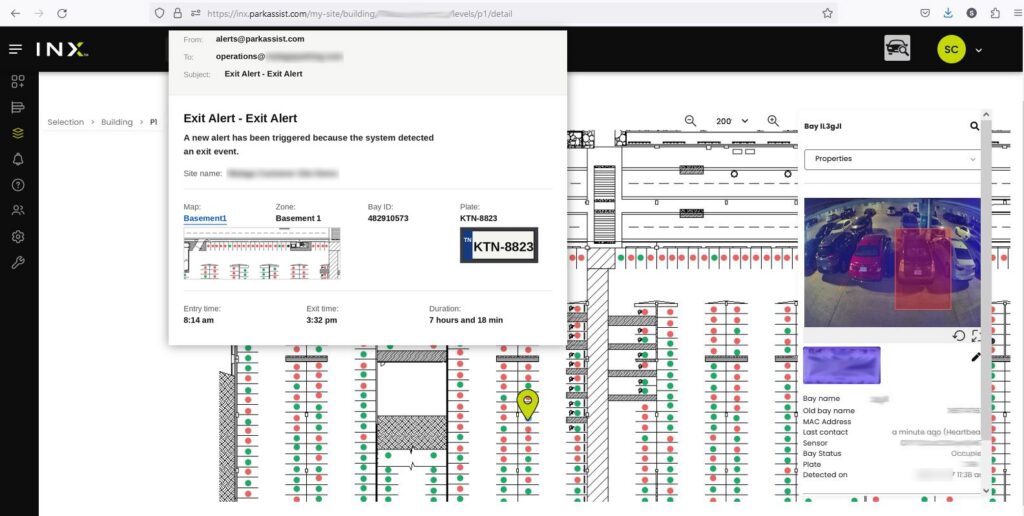
Unlike binary systems that rely on ultrasonic or in-ground sensors, HD camera-based solutions use overhead imaging technology to monitor multiple parking spaces simultaneously, space by space, and collect rich visual data. These systems can identify occupancy, capture license plate information, and even record real-time video footage, all from a single device. With this level of visibility, operators gain a far more comprehensive understanding of how their parking facilities are being used and can leverage that data to improve efficiency, security, and overall user experience.
| Pros of Camera-Based Systems | Cons of Camera-Based Systems |
| • Offer occupancy data and valuable insights into driver behavior, dwell time, repeat visits, and space turnover via LPR • Each sensor can continuously record HD video, contributing to real-time monitoring, faster incident resolution, forensic review, and enhanced facility safety • System accuracy can be verified by viewing each space in real-time, removing the need for onsite checks or recalibration • Verified 99% occupancy accuracy with automated reporting ensures performance without manual resets • No ultrasonic “ping,” meaning no sensor-generated noise pollution | • Higher upfront investment than other system types • Require supporting network infrastructure (power, connectivity) |
For many garage owners and operators, the added value of camera-based systems comes in the form of surveillance and safety. Camera-based parking guidance systems serve as a security tool that captures continuous video of the parking environment and provides visual evidence in the event of incidents or disputes. Not only can this be beneficial to drivers navigating insurance claims, but it also benefits facility owners by providing added security, relieving liability, saving legal fees, and providing a sense of security and confidence to drivers.
This makes a camera-based system a critical part of any modern security strategy, particularly for airports, casinos, hospitals, and mixed-use developments where safety is of the utmost importance.
The intelligence behind a camera-based system, like the Park Assist Solution from TKH Security, doesn’t just enhance the user experience. It directly contributes to higher utilization and revenue per square foot. With deeper insights into space availability and parker behavior, operators can:
Because camera-based systems deliver real-time occupancy and behavioral data, operators gain the ability to fine-tune their pricing models, streamline enforcement, and elevate space profitability in ways that binary or analog systems simply can’t match. In fact, a recent study showed that camera-based systems can drive up to a 10% increase in space utilization, translating into meaningful gains in revenue, efficiency, and driver satisfaction. For example, a garage operating at an average 85% occupancy could go from simply feeling full to being more truly full at 95% occupancy with camera-based technology.
This level of insight unlocks powerful new revenue opportunities, particularly when paired with advanced tools like Park SelectRate, which enables dynamic rate adjustments based on real-time demand.
It’s true that camera-based parking guidance systems generally have with a higher initial investment compared to alternatives. This is largely due to the advanced hardware involved, including high-definition cameras and onboard processors.
Focusing solely on the initial price tag overlooks the broader and long-term value camera-based systems deliver. While a basic system might help drivers find a space, a camera-based system transforms the parking facility into an intelligent, revenue-generating asset.
“It’s true that camera-based systems like ours come with a higher upfront investment,” says Sparrow. “But the long-term value is undeniable. With automated performance checks, robust analytics, built-in surveillance, and increased parker satisfaction, our clients see a faster ROI and a smarter facility overall.”
Whether you're planning a new facility or upgrading an outdated system, the choice between parking guidance systems isn’t just about detecting cars. It’s about future-proofing your operation. The M5 Smart-Sensor platform from TKH Security transforms parking from a passive utility into a proactive revenue generator, security system, and data engine.
Ready to upgrade to intelligent parking guidance? Learn more about the Park Assist M5 Smart-Sensor.
Healthcare facilities have always been places of healing, compassion, and care. Yet in recent years, conversations...

A major milestone has been reached at Detroit Metropolitan Wayne County Airport (DTW), where the new Park Assist...

The NIS2 Directive is reshaping how organizations across the EU approach cybersecurity — and increasingly, physical...